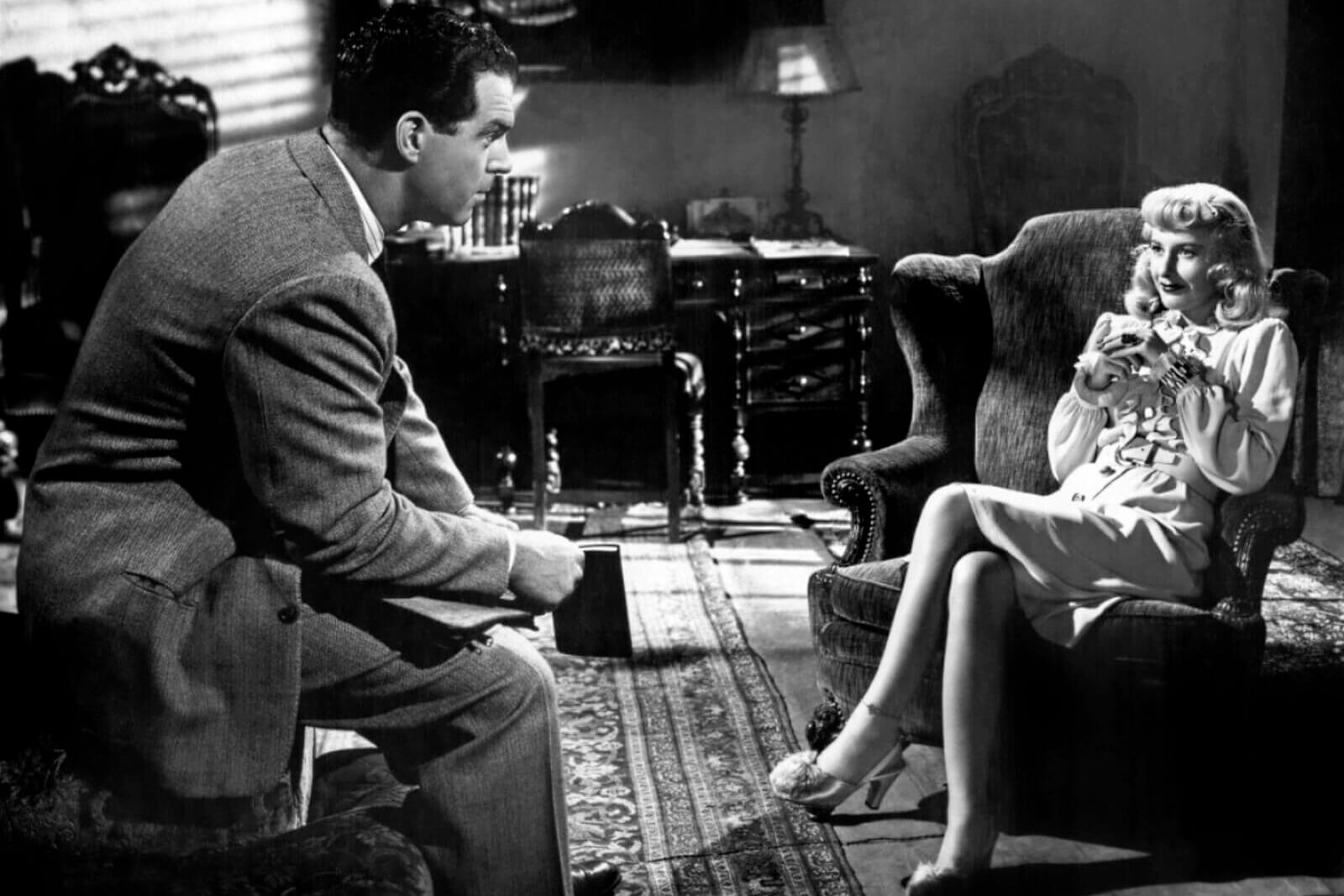
An era of post-war disillusionment, lighting contrasted with deep shadows, oblique lines that fragment space, asphyxiating environments, and a pessimism that psychologically disintegrates its protagonists. The Film Noir is difficult to define, yet easy to recognize. For many, it is not a cinematic genre (like the Western or the musical), but rather a style characterized by its tone or a specific historical period. Films such as Double Indemnity (1944), The Maltese Falcon (1941), and Out of the Past (1947) cemented the idea of a cinema that reflects a fractured society. But what exactly is film noir, and why does it remain so relevant?
Early Definitions: Style Over Genre
When we think of film noir, the first things that come to mind are the black-and-white aesthetic, a mystery to be solved, or the use of flashbacks that foreshadow a tragic end. However, these characteristics are insufficient to articulate a systematic definition. Fortunately, there have been very fruitful attempts to understand it. One of the most influential is that of screenwriter and director Paul Schrader in his article Notes on Film Noir (1972), where he argues:
“Film noir is not a genre. It is not defined, as are the western and gangster genres, by conventions of setting and conflict, but rather by the more subtle qualities of tone and mood.”
Schrader criticizes the search for an “objective” definition, as each critic tends to have their own list of essential films. Instead, he delves into the catalysts that gave rise to its creation.
The Catalysts: Why in the United States?
It is striking that it was not the Americans who identified the patterns of film noir, but French critics. Nino Frank was the first to point out these peculiarities in his text “Un nouveau genre ‘policier’: L’aventure criminelle” (1946). Frank noted that films like Laura (1944) no longer focused on the “whodunit” (the traditional mystery), but on criminal psychology and a raw social realism.
Schrader identifies four key points that served as a breeding ground:
- War and Post-war Disillusionment
This is a delayed reaction to the 1930s. While the Depression-era gangster films were socially conscious, a deep bitterness emerged at the end of World War II. Soldiers returned to a society they no longer recognized. A clear example is The Best Years of Our Lives (though not strictly noir, it shares that sentiment) or the cynicism of The Blue Dahlia (1946). - Post-war Realism
A desire for authenticity emerged. The public rejected the cardboard-and-plaster sets of the studios. This led to filming on location, such as the streets of New York in The Naked City (1948) or the back alleys of The Killers(1946). Noir abandoned high-society salons to position itself on the sidewalks with common people. - The German Influence
During the 1920s and 30s, the U.S. received European expatriates such as Fritz Lang, Billy Wilder, and Otto Preminger. These directors brought with them German Expressionism, characterized by the dramatic use of chiaroscuro. By merging the rawness of real streets with this artificial and theatrical lighting, the visual aesthetic of noir was born. We can see this in Lang’s mastery in The Big Heat (1953). - The “Hard-boiled” Tradition
The literature of authors like Raymond Chandler and Dashiell Hammett provided the prototype for the “tough” hero: cynical, narcissistic, and defeatist. Schrader points out that Chandler’s screenplay for Double Indemnity (1944) is the perfect example: Walter Neff, an insurance salesman, is seduced by the femme fatale Phyllis Dietrichson to murder her husband. Here, the dialogue is as sharp as a razor.
Aesthetics as Meaning
For Schrader, style is not an ornament; it is the tool that creates meaning. “The ‘how’ is always more important than the ‘what’.”
- Lighting (The Predominance of Night): There is an attempt to simulate darkness even in daytime interiors, using Venetian blinds to fragment the light. In The Big Combo (1955), the lighting is so extreme that characters seem to emerge from a black void.
- Composition (The Geometry of Instability): Oblique and vertical lines are preferred. The environment dominates the actor, suggesting that the individual is powerless. In The Lady from Shanghai (1947), the famous hall of mirrors scene visually fragments the protagonist’s identity.
- Water and Rain: There is a fixation with wet surfaces that reflect city lights, as seen on the docks of Criss Cross(1949). Rain usually increases in proportion to the dramatic tension.
- Narrative (A Feared Future): The use of voice-over and temps perdu (lost time) emphasizes that destiny is already written. The hero of Sunset Boulevard (1950) narrates his story while already dead!—the definitive example of fatalism.
Gangster Cinema vs. Film Noir
Schrader makes a final comparison with 1930s classics like Scarface (1932) or The Public Enemy (1931). Although they share the world of crime, Schrader considers film noir superior for these reasons:
- Reflection vs. Creation: Gangster cinema only “reflected” society; film noir interprets and attacks it.
- American Mannerism: Noir created a “nightmare world” that is a pure artistic creation, conscious of its own visual identity.
- Works of Art: For the author, films like Kiss Me Deadly (1955) or Gun Crazy (1950) achieve the status of works of art because they transcend sociology through their psychic complexity.
Personal Conclusion
As I research and write these lines on Film Noir, I reflect on why this subject serves as the ideal inaugural theme for this page. The answer remains elusive because, to be frank, there is no elaborate motive. Film Noir is inherently fascinating; crafting these texts provides a compelling pretext to immerse myself with enthusiasm and to learn not only about this specific movement, but about cinema itself as an art form.
How do images facilitate the construction of realities? In what ways does artistic creativity forge new modes of representation and experience? These are perpetually evolving questions whose answers shift according to the era, the movement, the nation, and the artists involved. To seek a totality of knowledge in a medium as magnificent and multifaceted as cinema is an idle pursuit—perhaps even heretical to those who view film through the lens of dogma. Nevertheless, if these directors and creators have proven anything, it is their perennial willingness to explore the new.
I have little more to add regarding Film Noir for now, but I trust this marks the beginning of something extraordinary.