
While I advocate for non-positivist approaches to art analysis, there is no reason to deny that numbers can be powerful allies. They help us understand consumption trends, where the money flows, and a few hidden secrets along the way. That is why we dove into the IMDb database—one of the most comprehensive in the world, with data updated through 2024. This allows us to understand not only which films are being produced but how we, as an audience, react to them. The core of this analysis is that it isn’t based (solely) on the verdict of academic cinephile experts, but on the democratic sentiment of millions of fans.
1. The Action Phenomenon: Popularity vs. Prestige
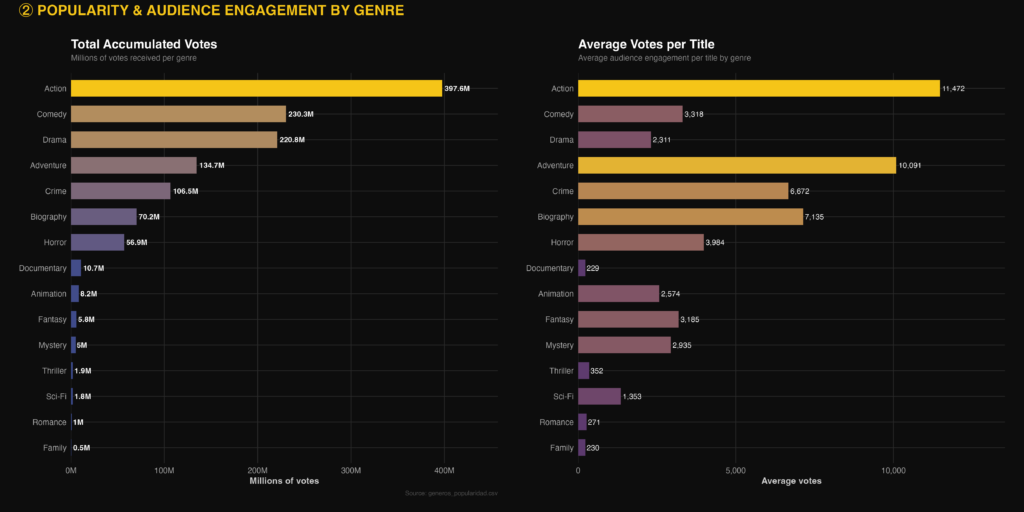
Fans of shootouts, car chases, and unbridled testosterone: raise your hands. The action genre is the perfect example of why ratings aren’t everything. It is the genre with the highest impact in terms of total votes, yet it carries some of the most volatile scores.
- Impact: Action has accumulated nearly 400 million votes (Chart 1) on IMDb for films averaging a 5.76 (on a 10-point scale). This sheer volume suggests these are the movies that truly drive popular culture and public debate.
- The Paradox of Memory: Many action movies with “mediocre” ratings are better remembered and more frequently cited than dramas with an 8.5. The total vote count acts as an indicator of cultural relevance, whereas the rating reflects technical satisfaction.
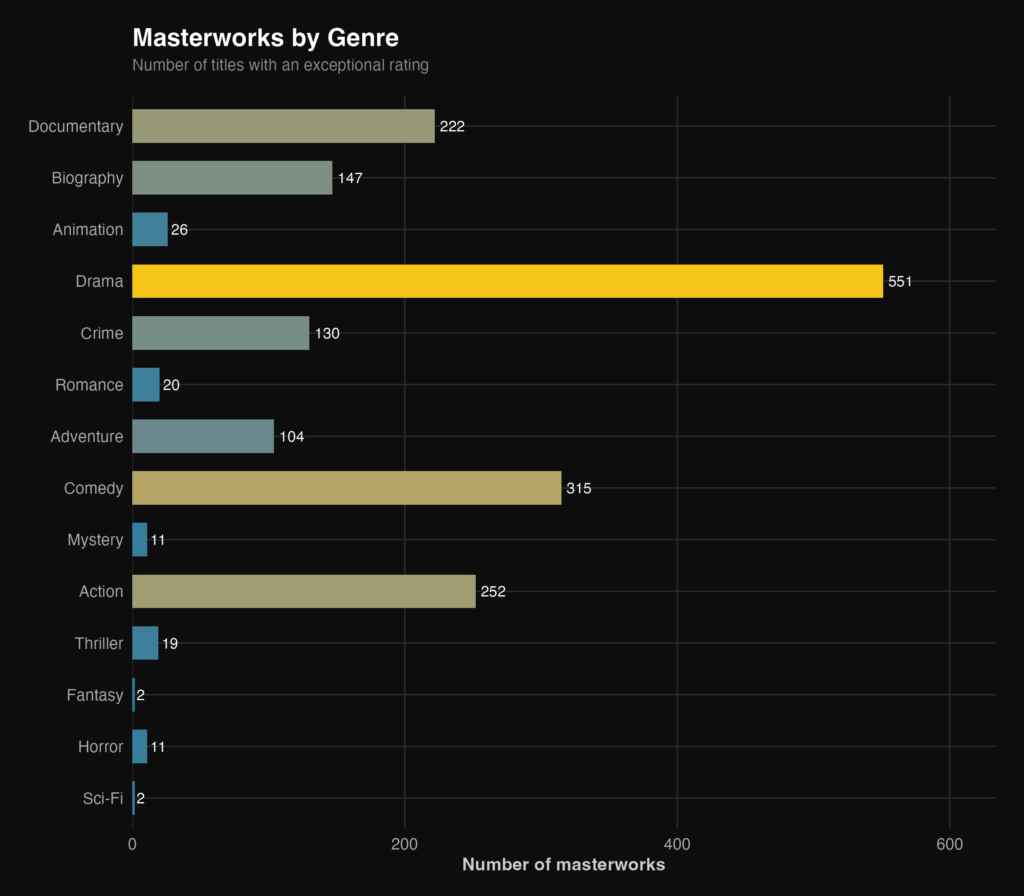
- The Standard of Excellence: Only 2.9% of action films break the 8.0 barrier (Chart 5) . This tells us that action fans are “easy to summon” (they vote in mass) but “hard to impress” (they rate strictly).
2. The Documentary Revolution: The Late 20th Century and the Digital Surge
In 1990, the documentary shifted from being an educational format to an entertainment giant, showing the most pronounced growth of any genre recorded on IMDb.
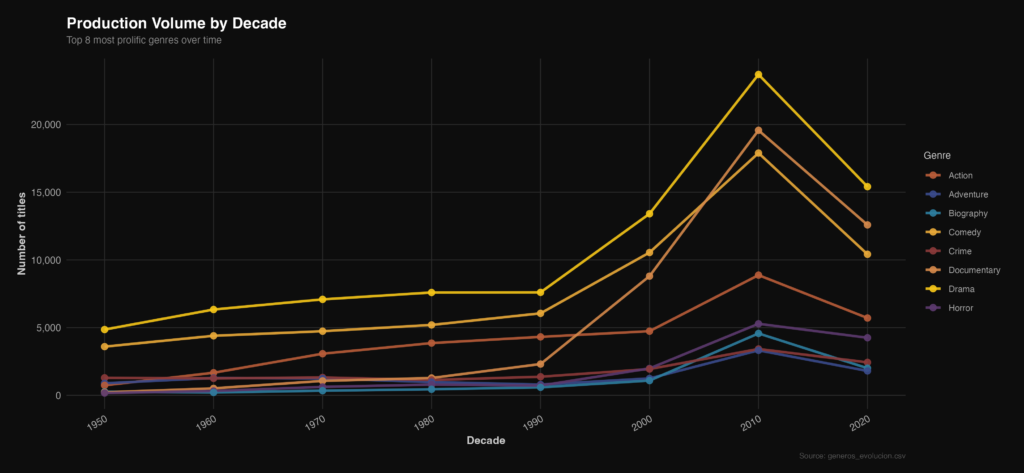
- Exponential Growth: Between 1950 and 1990 (the end of the 20th century), production was stable but low. However, from the 90s into the 21st century, production skyrocketed: from 2,300 titles in the 90s to nearly 20,000 in the 2010s (Chart 2).
- The Highest Excellence Rate: 14% of documentaries reach a rating of 8.0 or higher (Chart 5). This suggests that the audience for documentaries usually finds exactly what they are looking for, creating a niche of extremely high satisfaction.
- The Streaming Effect: This post-1990 surge is no accident; it responds to the democratization of digital cameras and, later, the need of platforms like Netflix and HBO for real, cost-effective content with high audience engagement.
- An Accessible Genre: Adding to the above, many filmmakers in developing countries with limited resources turn to documentaries to tell their stories. It has become a vital tool for struggle and resistance.
3. Drama: The Industry Benchmark
Drama remains the standard by which we measure cinematographic quality. It is the engine that maintains IMDb’s stability.
- Leader in “Gems”: With 551 titles rated above 8.0 (Chart 5), it is the genre that most frequently achieves universal acclaim. This is where fans and “experts” are most likely to agree.
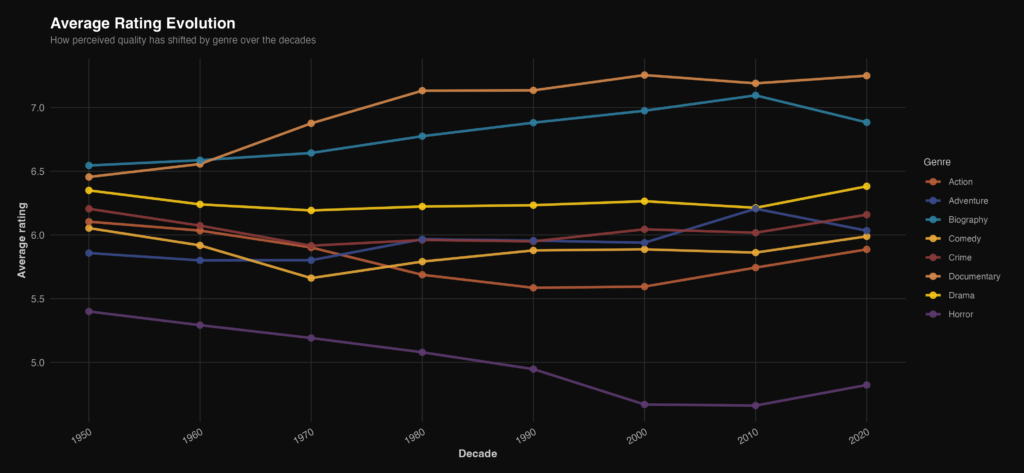
- Resilience Over Time: Unlike genres that fade out of fashion (such as the Western), Drama has grown every decade without losing its average rating—staying solid above 6.5 (Chart 4)—proving it is a “time-tested” genre.
- Massive Volume: It is the genre with the most titles in the database (over 95,000), indicating that it is the foundation upon which almost every other story (romance, crime, biography) is built.
4. Horror and Fantasy: The Audience’s Misunderstood
Here we find a fascinating data point: these genres have the lowest ratings but some of the most loyal fan communities.
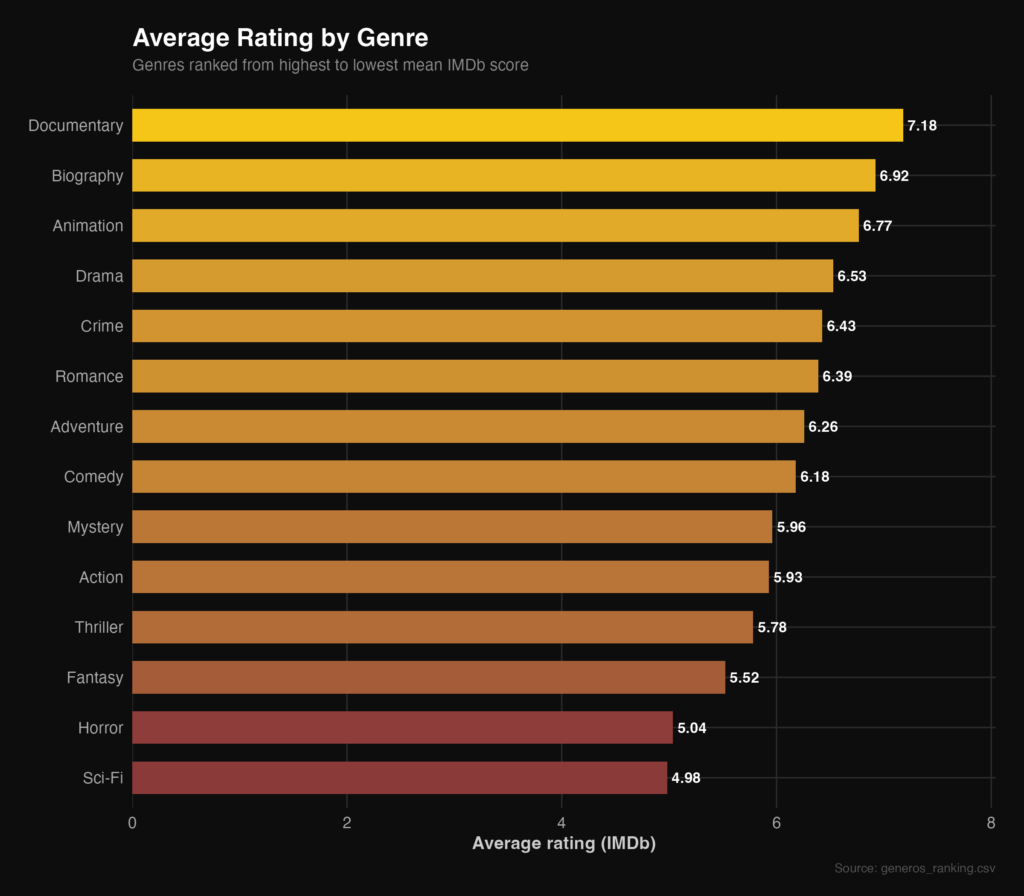
- The Rating Penalty: Horror has one of the lowest average rating on the chart (5.04). Does this mean they are “bad”? Not necessarily. It reflects a “cult” genre where the general public is often very harsh, yet loyal fans continue to consume it massively.
- The “Masterpiece” Difficulty: Less than 0.4% of horror films reach an 8.0 rating. It is the genre where achieving a consensus of excellence is most difficult, turning those few exceptions into true landmarks.
- Constant Engagement: Despite low ratings, production volume in Horror continues to grow, demonstrating that profitability and fan interest do not strictly depend on a high score.
Conclusion
At the end of the day, numbers are not the final verdict on the quality of a work, but they are the cartography of our collective emotion. As mentioned at the start, defending a non-positivist analysis of cinema means understanding that beauty cannot be tabulated; however, ignoring this data would mean closing our eyes to how the world truly consumes and experiences the “Seventh Art.”
IMDb data reveals that the industry is a living organism:
- It shows us that Drama remains the safe harbor of narrative.
- That Documentaries have become the new democratic frontier for real stories post-1990.
- That Action possesses a cultural relevance that ratings don’t always capture.
- And that Horror exists in a state of constant demand, where cult followings outlive any low score.
This analysis doesn’t seek to dictate what you should watch, but rather to offer a compass to understand the forces moving the money, time, and interest of millions of viewers. Cinephilia and data science don’t have to be enemies; when they meet, they allow us to see “behind the screen” with a clarity that neither could achieve alone.
What trend did we miss? The conversation, much like cinema itself, remains open.
We have provided the data tables below so you can explore the information in detail yourself.