
For decades, the dominance of Hollywood and major film hubs was unquestioned. However, within critical circles, a consensus has emerged: the neoliberal grip on the arts has led to a decay in cinematic substance. In his seminal work Capitalist Realism (2009), Mark Fisher argued that it is easier to imagine the end of the world than the end of capitalism- a sentiment reflected in a film industry that prioritizes “market-safe” reboots over original vision. Fredric Jameson echoed this in his analysis of postmodernism, describing a “cultural logic” that favors pastiche and surface-level aesthetics over depth.
This sentiment reached a fever pitch when Martin Scorsese famously declared in The New York Times (2019) that Marvel movies are “not cinema,” but rather “theme parks.” While critics have long debated this qualitatively, the data now provides a quantitative verdict: as a film industry grows in volume, its consistency in quality collapses.
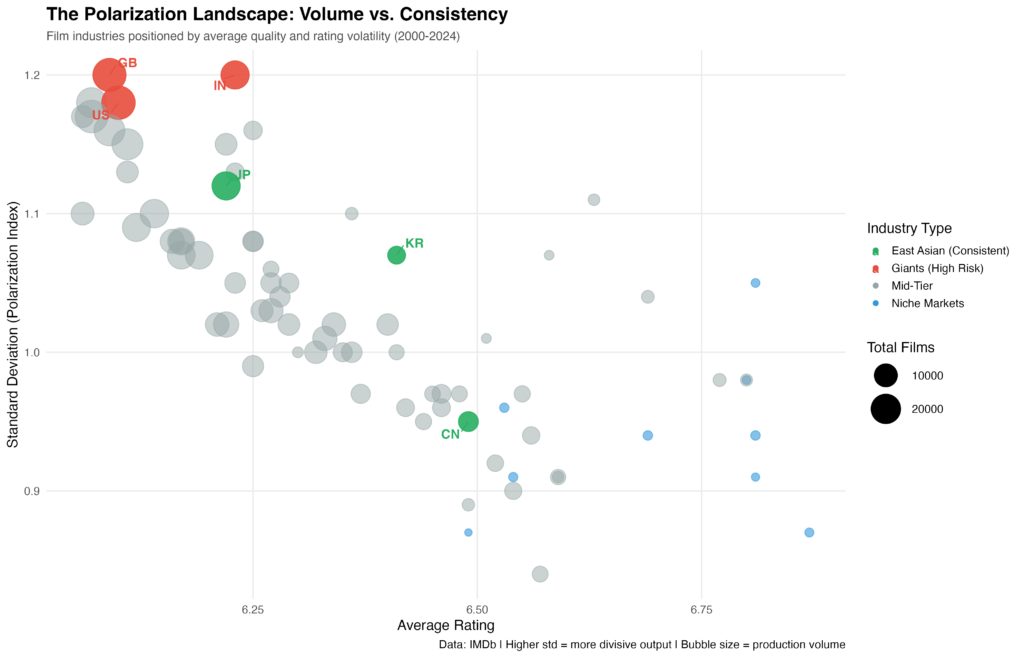
Using the massive database from IMDb, the analysis reveals a stark reality: the larger the industry, the more erratic the quality. This is the Polarization of Giants.
The Giants’ Gamble: High Volume, High Risk
When we look at the industrial titans—the United States, the United Kingdom, and India—the data shows a fascinating, yet troubling, pattern. According to the analysis, these regions exhibit the highest Standard Deviations (around 1.20).
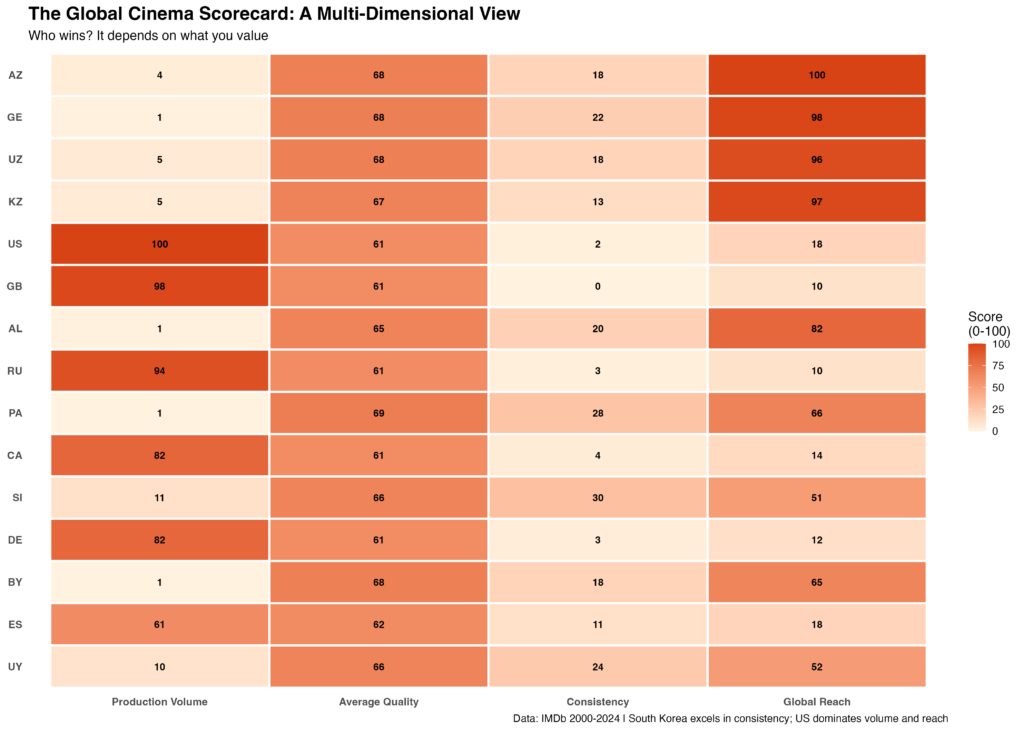
This high volatility suggests that for every Oppenheimer or Parasite that breaks through, there are hundreds of low-quality, formulaic productions saturating the market. These giants operate on a high-risk, high-volume model. In my heatmap visualization (01 Polarization Landscape and 06 Global Scorecard), these regions appear in “critical colors,” highlighting how the pursuit of market dominance leads to a “coin-flip” experience for the viewer. You might see a masterpiece, or you might see a corporate product devoid of artistic intent.
The East’s Golden Standard: Consistency is King
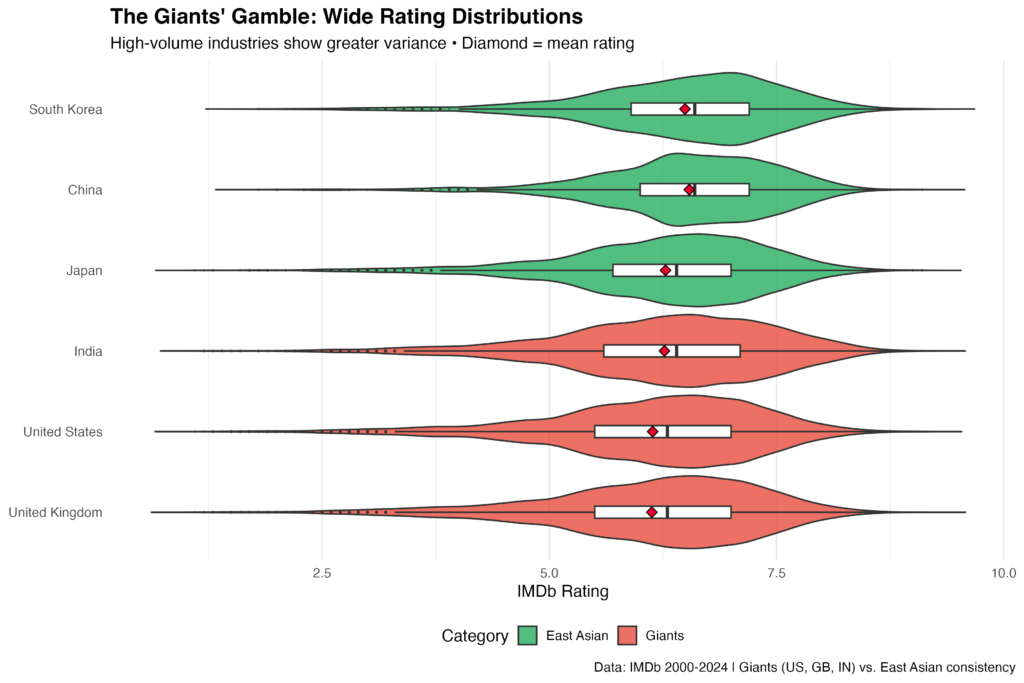
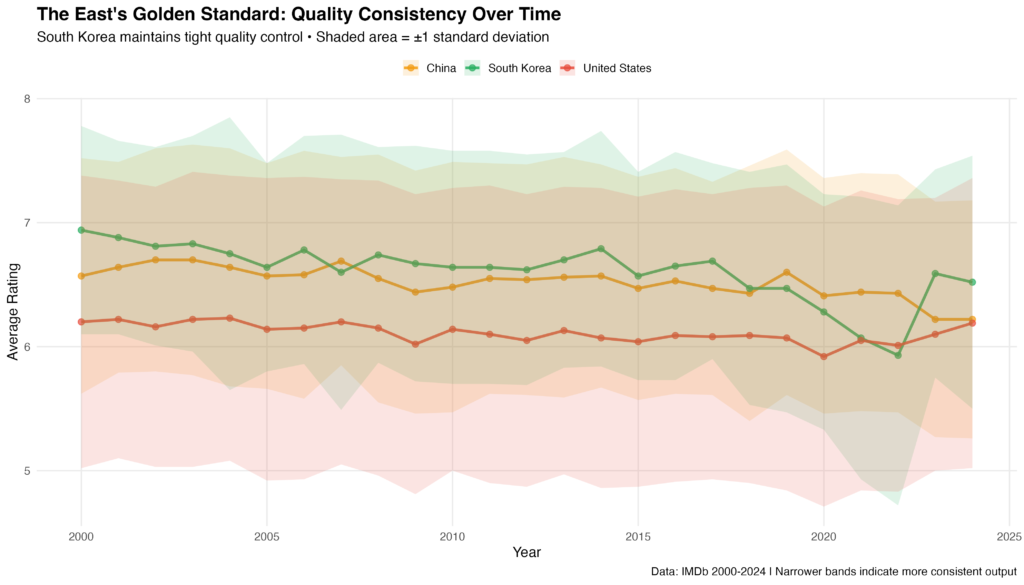
In contrast to the Western “all-or-nothing” approach, new powers are perfecting the art of the consistent output. South Korea and China stand out as the new benchmarks for quality control.
- South Korea (KR): Boasts an average rating of 6.41 with a remarkably low deviation of 1.06.
- China (CN): Shows even tighter consistency with a deviation of only $0.95$.
Why does South Korea command the highest average vote count (102,401)? It is because their industry has built global trust. When an audience sees a Korean production, there is a statistical guarantee of a certain level of technical and narrative prowess. This “Golden Standard” suggests a studio system that prioritizes a reliable baseline of quality over the chaotic saturation practiced by Hollywood or Bollywood. (02_giants_distribution)
Niche Excellence vs. Industrial Output
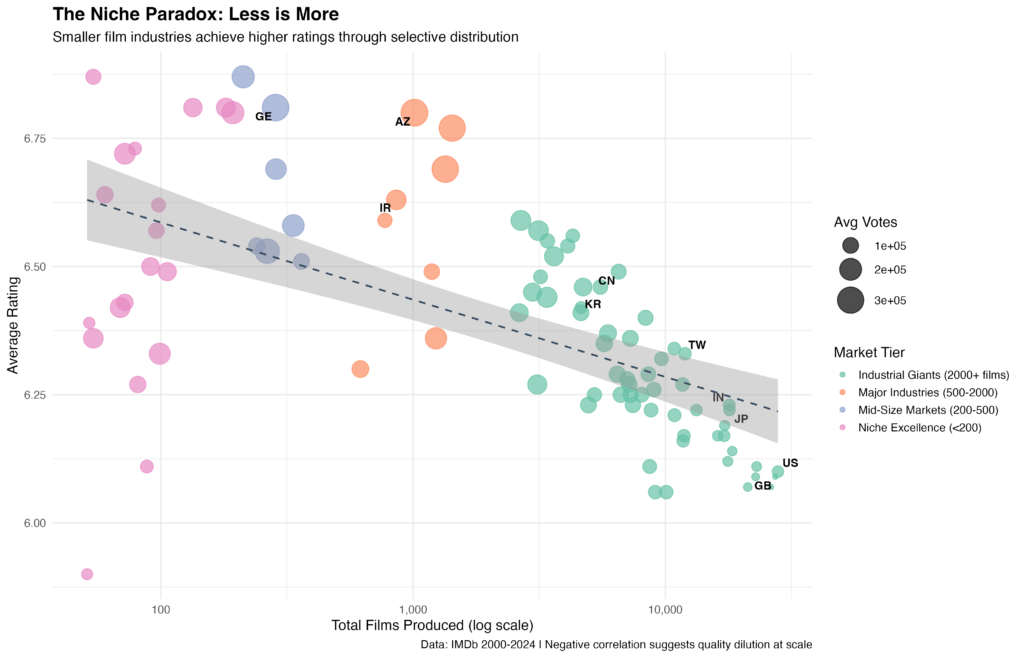
The data also reveals “pockets of perfection” in unexpected places. In 01_calidad_por_region.csv, countries like Azerbaijan and Georgia boast ratings as high as 6.9. However, this isn’t a sign that they are “beating” the giants in industrial terms.
This is what I call the Niche Effect. These cultures don’t produce for mass global export; they produce for artistic necessity. Only their absolute best works reach the international stage to be rated. It is a “purity of data” that the giants, in their quest for total maion, can no longer afford to maintain.
Sociological Impact: How We Consume Cinema Today
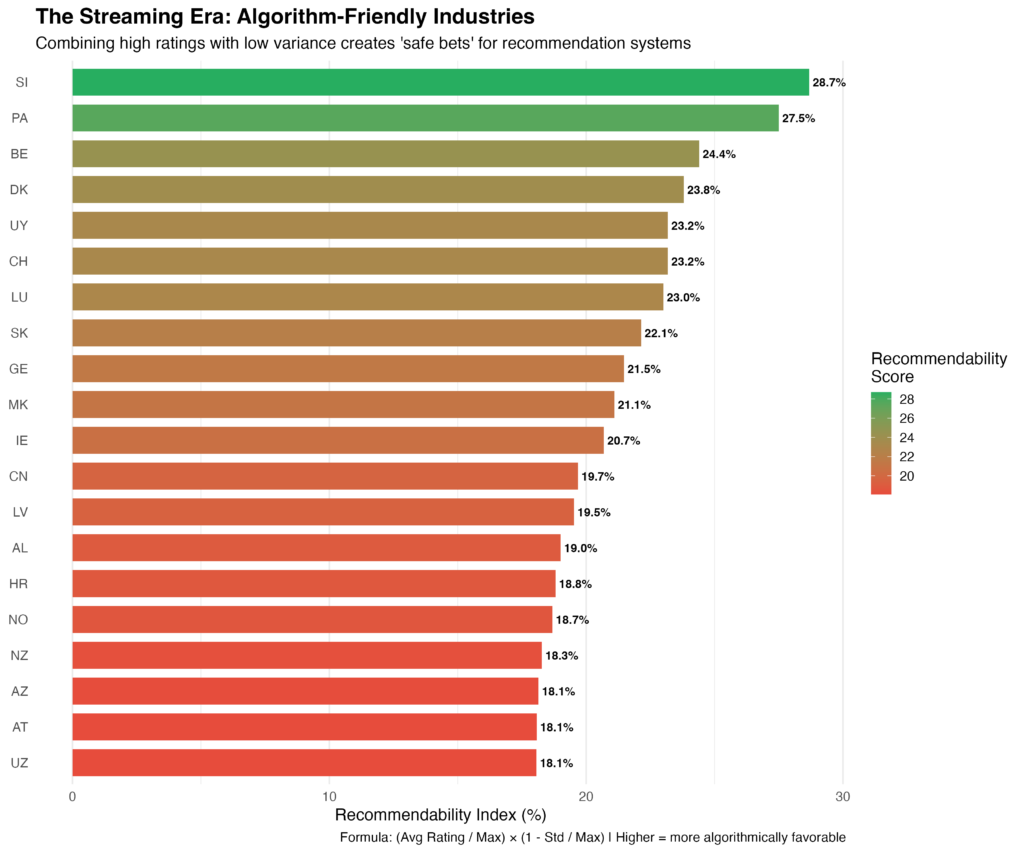
In an era dominated by streaming algorithms, this data explains a shift in viewer behavior. Algorithms favor “watchability” and “retention.” When the US industry becomes too polarized, the algorithm begins to perceive it as a risk.
Conversely, the consistency of Korean or Chinese cinema makes them “algorithmically safe.” We are witnessing a shift where the audience is moving away from the “Giant’s Gamble” and toward industries that offer a guaranteed quality floor. We no longer ask, “Is this movie good?” but rather, “Is this origin reliable?”
Conclusion: The Future of the Global Screen
The data is clear: the size of a film industry is often inversely proportional to its quality stability. As the neoliberal model forces giants to prioritize volume, they lose the very thing that made them iconic: the ability to consistently tell meaningful stories.
The future of the global screen does not belong to those who produce the most, but to those who can close the gap of polarization. The next time you look for a movie, don’t look at the marketing budget; look at the origin. In the age of the algorithm, geographical consistency is the new film critic.
Note on Methodology: All data analysis and visualizations presented in this article were developed by the author using a comprehensive dataset derived from IMDb. For more details on the specific metrics, refer to the source files: 05_polarizacion.csv, 01_calidad_por_region.csv, and the accompanying regional heatmaps.