A data-driven look at the most popular film genres of all time, using IMDb's dataset. See which genres dominate, which audiences rate highest, and how cinema has changed
Every film genre is a promise. A comedy promises laughs. A thriller promises tension. A documentary promises truth—or at least a version of it. And over time, those promises tell us something bigger about what filmmakers want to make, what studios think will work, and what audiences keep coming back for. This analysis looks at how film genres have evolved over time using the IMDb non-commercial dataset.
I grouped films by their IMDb genre tags, counted multi-genre films in every category they belong to, and used ratings and vote counts—filtered to films with at least 1,000 votes where relevant—to separate broad popularity from actual audience response.
The result is a simple question with a surprisingly rich answer: what kinds of movies have defined cinema, and how has that changed?
The big picture — which genres dominate in cinema?
If you had to guess the most common film genre of all time, you’d probably land on drama—and you’d be right…at least initially.
Drama sits far ahead of every other genre, with 235,398 films tagged that way in the dataset. It’s simply in a different league. Behind it come documentary (135,035) and comedy (107,250), followed by a sharp drop to action and romance, both just under 49,000.
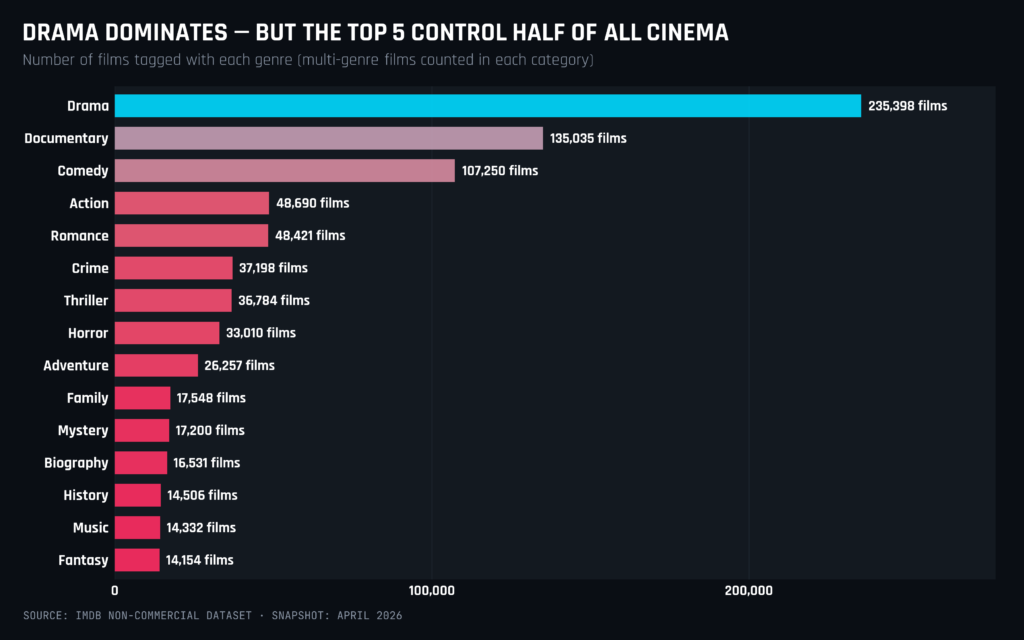
This tells us that cinema has a clear “big three,” but after that, the market fragments quickly. There’s no single fourth or fifth genre that comes close to the leaders. Instead, the rest of the genre landscape stretches into a long tail: crime, thriller, horror, adventure, family, mystery, biography, history, music, fantasy, and beyond.
And there’s an important caveat here: genres overlap. A single film can be a drama-romance, a crime-thriller, or a documentary-biography. So these aren’t exclusive boxes. They’re tags—signals of tone, structure, and audience expectation. That’s one reason drama towers over the field: it functions almost like the default language of cinema, a label broad enough to absorb everything from intimate character studies to prestige historical epics.
Still, the concentration at the top is striking. The top five genres account for an enormous share of all genre tags, suggesting that while film culture feels endlessly diverse, a relatively small set of storytelling modes has done most of the heavy lifting.
In other words: cinema has many flavors, but a handful dominate the menu.
How genre popularity has shifted over time
The really interesting story starts when you stop looking at the total and start looking at the timeline.
Drama: still on top, but losing ground
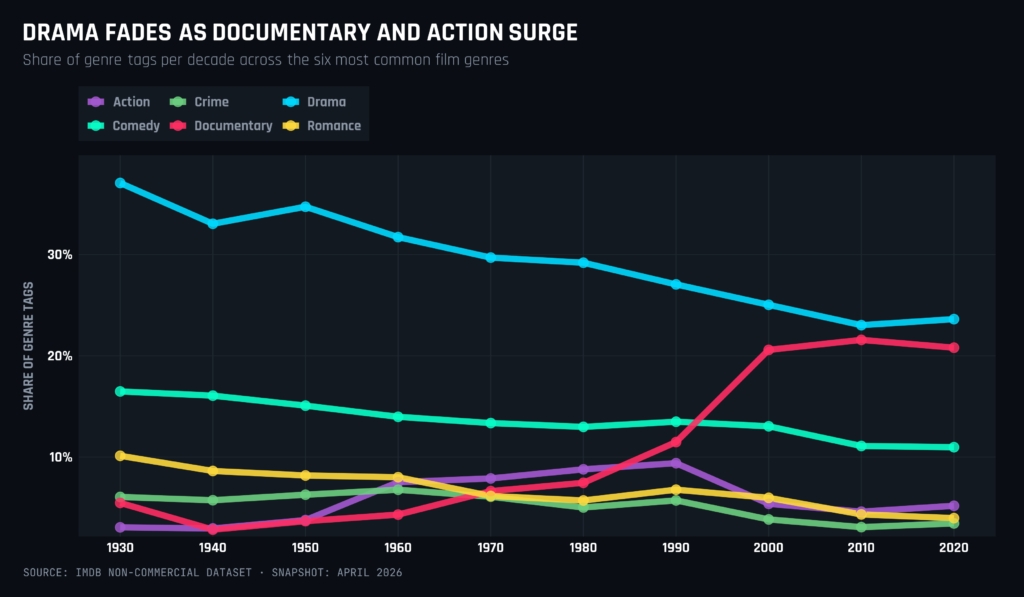
For most of modern film history, drama was even more dominant than it is today. In the 1930s, it accounted for roughly 38% of genre tags among the top six genres. By the 2020s, that share had fallen to around 24% (Graphic 2). Drama is still the biggest genre—but it no longer rules the screen quite so completely.
That decline doesn’t mean drama disappeared. It means the genre ecosystem got more crowded.
Documentary: the breakout story of modern cinema
The clearest winner of the past few decades is documentary. It starts as a relatively small slice of the genre mix in the early decades, then rises sharply—especially after 1990—reaching more than 20% by the 2000s and 2010s (Graphic 2). That surge likely reflects several overlapping shifts: cheaper digital production, the rise of streaming, wider global distribution, and a growing audience appetite for real-world stories told with cinematic polish.
Action: the rise, peak, and reinvention of a genre
Action tells a different kind of story. It grows from a minor category in the early decades to a much bigger force by the late 20th century, peaking around the 1990s before easing back somewhat (Graphic 2). That arc feels familiar: as filmmaking technology improved and blockbuster economics took over, action became one of cinema’s most exportable languages. The genre’s classical era began in the early 1980s, when stars like Schwarzenegger and Stallone turned the action hero into a brand. Then Die Hard (1988) introduced the everyman template — a wisecracking, vulnerable protagonist who proved just as bankable as the muscle-bound archetype — and widened the genre’s appeal overnight.

The 1990s were the true peak. Terminator 2 showed that CGI could be a storytelling tool, not just a gimmick; Mission: Impossible turned Tom Cruise into a franchise engine; and The Matrix fused Hong Kong choreography with digital effects and philosophical ambition into something that felt entirely new. After 2000, the lone hero gradually gave way to ensemble universes — Iron Man (2008) didn’t just launch a character, it launched an industry model — and the genre’s share in the data eases back. But the DNA of those 1980s and 90s breakthroughs is still visible in every Marvel, Fast & Furious, and franchise sequel that fills theaters today
Comedy, romance, and crime: the slow flattening
Then there’s comedy, which doesn’t collapse so much as flatten. It begins strong, slips gradually across the decades, and settles into a lower but still substantial share. That “plateau” is revealing. Comedy never stopped mattering—but it stopped expanding at the same pace as documentary and action. In a fragmented media world, laughs may have become easier to find outside the movie theater.
Meanwhile, romance and crime both trend downward over the long run, with romance seeing one of the clearest declines of all. Once a major pillar of film production, it now occupies a smaller, more specialized share of the genre mix.
Taken together, the chart shows a slow redistribution of attention. Film genres don’t usually disappear. They get crowded, remixed, and pushed into new roles.
What audiences actually rate highest
Popularity is one thing. Appreciation is another.
When we look at IMDb ratings for films with at least 1,000 votes, the leaderboard shifts in a big way. The highest-rated genres aren’t the loudest or the most heavily marketed. They’re the ones that tend to leave a strong impression on the people who seek them out.
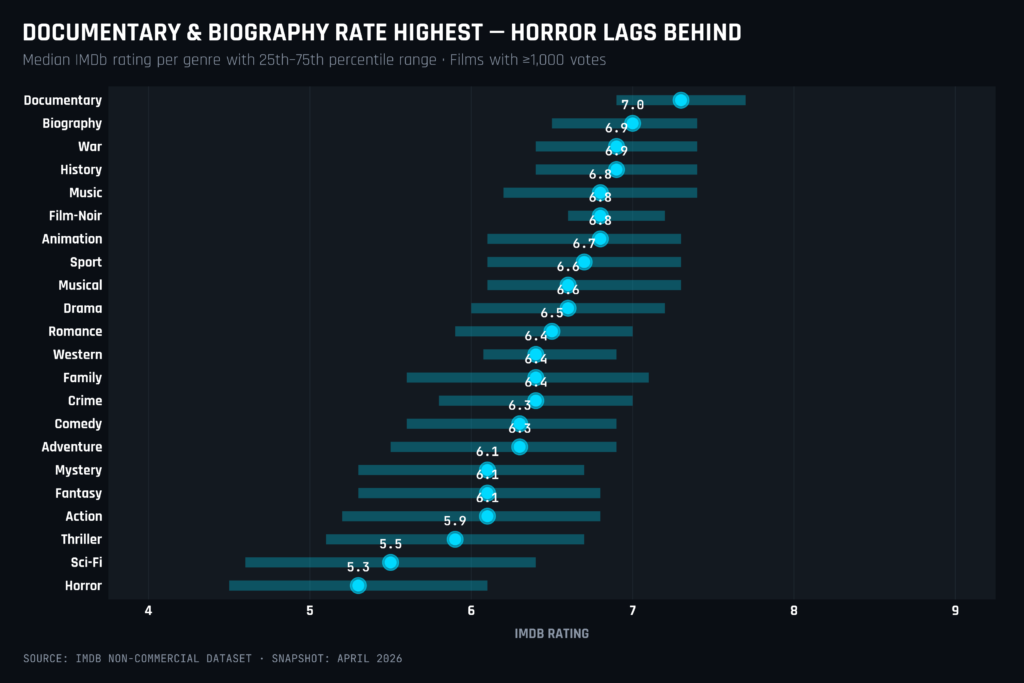
At the top sits documentary, with a median rating of 7.0. Right behind it are biography and war at 6.9, followed by history, music, and film-noir around 6.8.
That’s a fascinating result. Documentary isn’t just growing in volume—it’s also winning on perceived quality.
Drama, despite being the most common genre by far, lands at a solid 6.5. That’s respectable, but not exceptional. In some ways, that makes sense: drama is so broad that it contains both masterpieces and a huge amount of middle-of-the-road output.
Further down the ranking, some of the most commercially visible genres underperform. Comedy comes in at 6.3, action at 5.9, thriller at 5.5, sci-fi at 5.3, and horror also at 5.3—the lowest median in the chart.
Horror’s position is especially interesting. It has a loyal audience, a huge cultural footprint, and decades of influence—but its median ratings trail almost everyone else. That may be less an indictment of the genre than a sign of how it works: horror invites risk, experimentation, divisiveness, and low-budget volume. It produces passionate fans and memorable highs, but also plenty of films that audiences rate harshly.
So if the quantity chart shows what gets made, the ratings chart shows what gets admired. And those are not always the same thing.
The genres people engage with most
Ratings tell us how much people liked a film. Vote counts give us a rough sense of how many people showed up to have an opinion at all.
That’s where the quality-popularity map becomes especially useful, because it separates mass attention from niche acclaim.
Some genres live in the sweet spot. Biography stands out with both high ratings and high median votes, suggesting a genre that attracts broad interest without sacrificing quality. Animation also performs well here, pulling strong engagement and strong ratings—a reminder that it appeals to far more than just children.
At the mass-audience end, adventure draws some of the highest median vote counts in the dataset. It may not top the ratings table, but it clearly brings in large audiences. The same is true, to varying degrees, for crime, animation, and sci-fi.
Then there are the prestige genres. Documentary sits high on rating but much farther left on votes. In plain English: people who watch documentaries tend to rate them well, but the typical documentary reaches a smaller audience than the typical adventure or animated film.
And then there’s horror, sitting in a very distinctive corner: relatively modest ratings, but meaningful audience engagement. That’s the shape of a cult genre. Horror doesn’t need universal approval to thrive. It just needs committed fans—and it has them.
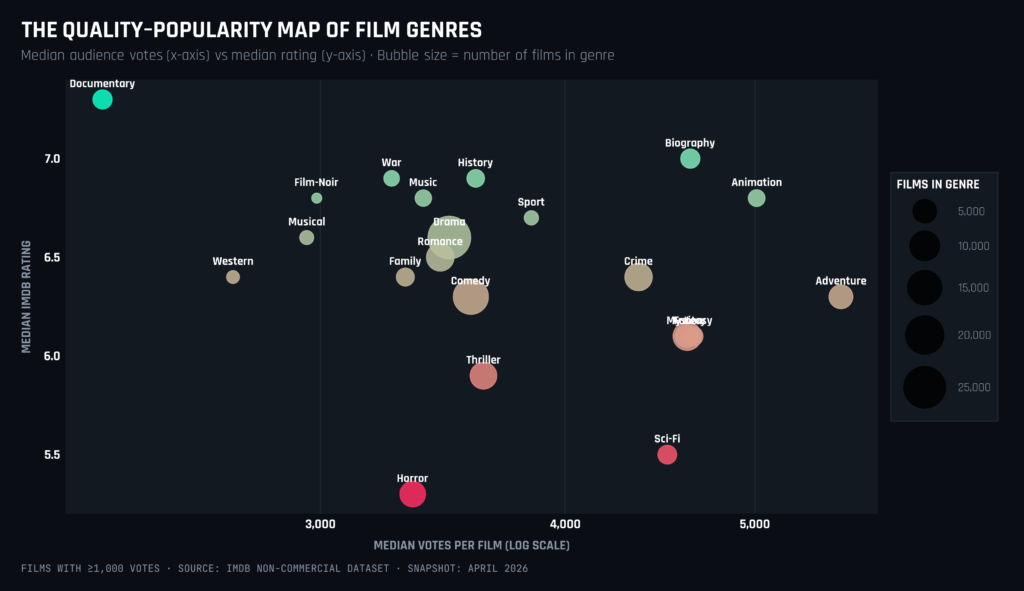
The middle of the chart is crowded with the genres that define everyday movie culture: drama, comedy, romance, and thriller. These aren’t always the most beloved or the most engaged-with on a per-film basis, but they remain the backbone of the medium. They’re the genres audiences return to again and again, even when they don’t spark the strongest reactions.
That’s the bigger lesson of this chart: success in film doesn’t come in one form. Some genres win by reaching everyone. Others win by deeply satisfying a smaller crowd.
Key takeaways: popularity vs. appreciation in film
- Drama is still cinema’s default mode, but its dominance has steadily weakened as the genre landscape has diversified.
- Documentary is the standout growth story, rising sharply in recent decades and also posting the strongest median ratings.
- Comedy remains a pillar of film culture, but its long-term share has flattened rather than expanded.
- Popularity and quality don’t perfectly align: the most common genres are not always the most highly rated.
- Horror is a classic high-engagement, low-median-rating genre—less universally loved, but clearly supported by a passionate audience.
This is just the first chapter in the story. Next up we’ll talk about how runtime has changed over time, which genres travel best across countries, and the directors, actors, and writers most closely associated with each corner of cinema.